


|
|

| |||||
| |||||
Former Commission officials Michel Petite, Robert Klotz and Lars KjølbyeNominated for going through the revolving door from the European Commission to law firms lobbying for industry clients. 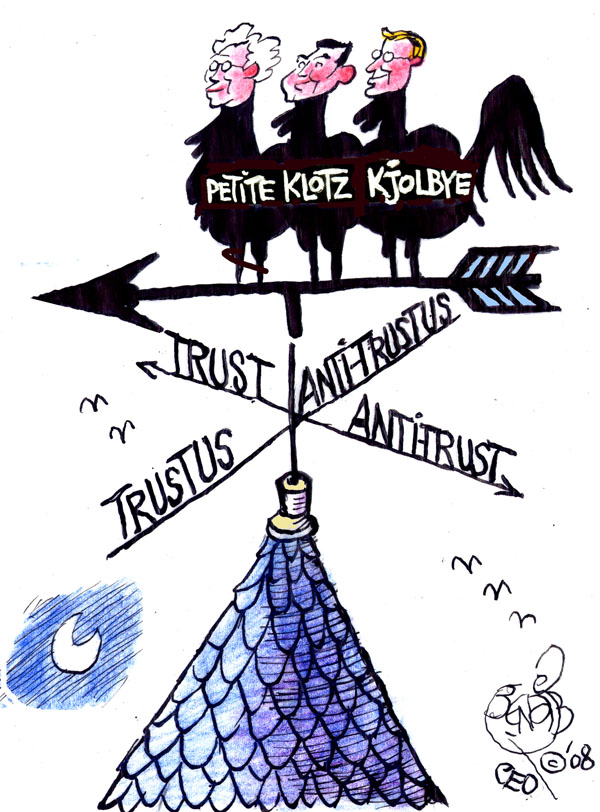
Michel Petite, Robert Klotz and Lars Kjølbye were all high-level Commission officials with central roles in the European Commission’s competition policy who in the last twelve months have taken up new jobs with major law firms specialized in assisting corporate clients on competition issues.
Judging the extent of these conflicts of interest is made impossible as all three law firms have explicitly rejected requests for lists of clients. This secrecy about their lobbying activities conceals whether the three ex-Commission officials are working on the same dossiers they covered before, or for clients that they might have dealt with in their previous role. None of the three law firms have registered in the European Commission’s voluntary register of lobbyists. The three ex-officials and the law firms have not breached any rules by moving. The European Commission has no ‘cooling off period’ for officials moving to the private sector. Petite, Klotz and Kjølbye are now all working for law firms that also offer lobbying assistance to corporate clients. In many countries around the world, ‘cooling off periods’ apply to prevent the abuse of insider information, inappropriate use of personal influence or the suspicion of rewarding past decisions that benefited the new employer. Vote for Petite, Klotz and Kjølbye if you are concerned about ex-Commission officials using their inside knowledge and personal contacts for the benefit of corporate clients eager to expand access and influence over EU policy-making.
Additional information :Law firms remain in the shadows, Brussels sunshine blog, Corporate Europe Observatory, 17 October 2008. Comments259 Chris 17 April 2009: What the heck do you have against insiders working for the industry? If you are insider it is also called “qualification”. Do you fear that there is some secret knowledge in a common institution? I think you are a bit far away in Ivytowerworld. Probably none of you worked for a profitable business yet. Without lobbying democracy would be poor and lead by some theories. You need the experience and influence from those who are influenced by legislation. If not, we would be living in autocracy. 225 LDF: Show who you are 8 December 2008: @Michael Tscherny: I think everybody knows that politicians work very often after being retired for such companies, and that is their right. Just look at Gerhard Schröder, only one example. But we have to define rules what they are allowed to do afterwards, otherwise they will work for the EU in order to get the next job to influence people when they are able. AND THAT IS NOT THE GOAL!!!! Politicians have to have a key to change something during their period as being responisble. But they should not use it for their or others personal interest. Everybody who is not influenced by any personal interest in this blog will agree with me – I am sure!!! 199 DESRUMAUX 21 November 2008: TOUS TROIS BALAYENT LE PEU DE CONFIANCE QUI EST ACCORDEE A L’EUROPE 74 Ingeborg Holst 21 October 2008: Lobbyisten- und Politikerfilz ist eine Schande und untergräbt die letzten Reste von Demokratie! 55 Sandra Fornasier 21 October 2008: Da muss die Schweiz unbedingt in die EU ! So ein paar “Rechtsverdreher” hätten wir auch noch … 34 petite, klotz, kjoelbye 21 October 2008: I vote for this 3 candidates for knowledge and contacts 9 Tjhooker 20 October 2008: Bin dafuer 2 Michael Tscherny 20 October 2008: You are wrong in stating that no rules apply to officials going to work in the private sector. For people leaving DG COMP in particular, there are very clear obligations – namely: 1. Not to contact or turn up at DG COMP for a certain period of time, so as not to being in a position where they “lobby” former colleagues; 2. Not to work on any dossiers they had profesional knowledge of. These rules could well qualify as “cooling off”. The fact that people go to work for law firms – or the other way around, which no-one seems to find arguable – is not in itself a cionflict of interest. You should also accept that law firms (as well as lobbying companies) have a certain turnover of clients and cases. In the competition policy area in particular, investigations come to an end at a certain time; so why would an ex-official not be allowed to work on a new case that he has indeed not be involved in previously? | |||||
|
The Worst EU Lobbying Awards are organised by Corporate Europe Observatory, Friends of the Earth Europe, LobbyControl and Spinwatch. This site is developed by easyMIND. |