


|
|

| |||||
| |||||
Anciens hauts fonctionnaires Michel Petite, Robert Klotz et Lars KjølbyeSélectionnés pour être passés du côté de cabinets d’avocats faisant du lobbying pour des clients du secteur industriel. 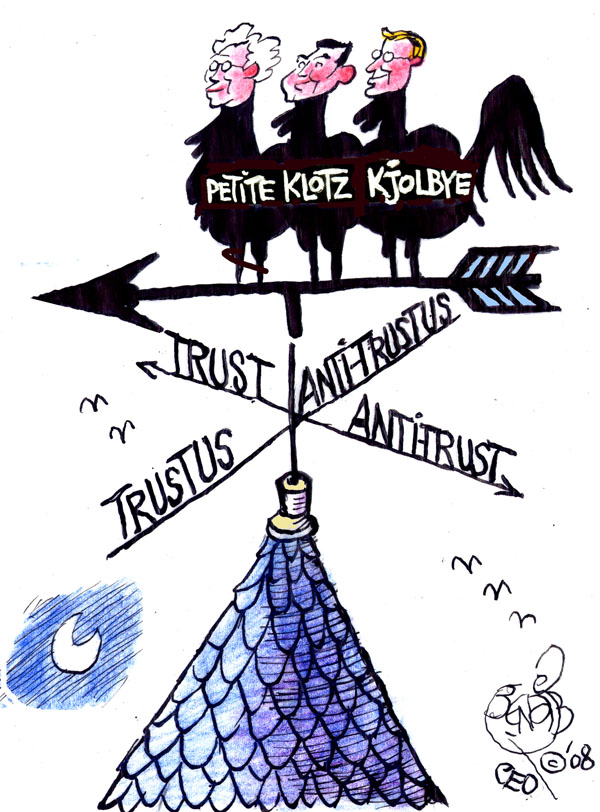
Michel Petite, Robert Klotz et Lars Kjølbye étaient tous trois hauts fonctionnaires de la Commission européenne, chacun jouant un rôle décisif dans la politique de la concurrence de la Commission et ayant accepté aux cours des douze derniers mois de nouveaux postes auprès d’importants cabinets d’avocats spécialisés dans le conseil aux entreprises en matière de concurrence.
Il est impossible de juger l’ampleur de ces conflits d’intérêts puisque ces trois cabinets d’avocats ont explicitement refusé de divulguer les noms de leurs clients. Leurs activités de lobbying tenues secrètes, il est impossible également de savoir si ces trois anciens fonctionnaires de la Commission travaillent sur les dossiers qu’ils suivaient déjà auparavant ou pour des clients à qui ils ont eu affaire dans leur précédente fonction. Aucun de ces trois cabinets d’avocats n’a fait la démarche de s’inscrire sur le registre facultatif de la Commission européenne recensant les lobbyistes. Ces trois anciens fonctionnaires européens et les trois cabinets d’avocats cités n’ont transgressé aucune loi, la Commission européenne n’ayant instauré de période de carence pour les fonctionnaires passant du public eu privé. Michel Petite, Robert Klotz et Lars Kjølbye travaillent désormais tous trois pour des cabinets d’avocats proposant des services de lobbying à leurs clients. Dans de nombreux pays du globe, une telle période de carence permet d’éviter la divulgation d’informations d’initiés, l’usage abusif d’une influence personnelle ou la perception de récompenses pour les décisions passées favorables au nouvel employeur. Votez pour Michel Petite, Robert Klotz et Lars Kjølbye si cela vous inquiète que d’anciens fonctionnaires de la Commission européenne mettent leurs connaissances d’initiés et leurs contacts personnels au profit d’entreprises avides de renforcer leurs entrées à la Commission et leur influence sur les prises de décisions au niveau européen. Pour plus d’informationLaw firms remain in the shadows, Brussels sunshine blog, Corporate Europe Observatory, 17 octobre 2008. Réactions259 Chris 17 April 2009: What the heck do you have against insiders working for the industry? If you are insider it is also called “qualification”. Do you fear that there is some secret knowledge in a common institution? I think you are a bit far away in Ivytowerworld. Probably none of you worked for a profitable business yet. Without lobbying democracy would be poor and lead by some theories. You need the experience and influence from those who are influenced by legislation. If not, we would be living in autocracy. 225 LDF: Show who you are 8 December 2008: @Michael Tscherny: I think everybody knows that politicians work very often after being retired for such companies, and that is their right. Just look at Gerhard Schröder, only one example. But we have to define rules what they are allowed to do afterwards, otherwise they will work for the EU in order to get the next job to influence people when they are able. AND THAT IS NOT THE GOAL!!!! Politicians have to have a key to change something during their period as being responisble. But they should not use it for their or others personal interest. Everybody who is not influenced by any personal interest in this blog will agree with me – I am sure!!! 199 DESRUMAUX 21 November 2008: TOUS TROIS BALAYENT LE PEU DE CONFIANCE QUI EST ACCORDEE A L’EUROPE 74 Ingeborg Holst 21 October 2008: Lobbyisten- und Politikerfilz ist eine Schande und untergräbt die letzten Reste von Demokratie! 55 Sandra Fornasier 21 October 2008: Da muss die Schweiz unbedingt in die EU ! So ein paar “Rechtsverdreher” hätten wir auch noch … 34 petite, klotz, kjoelbye 21 October 2008: I vote for this 3 candidates for knowledge and contacts 9 Tjhooker 20 October 2008: Bin dafuer 2 Michael Tscherny 20 October 2008: You are wrong in stating that no rules apply to officials going to work in the private sector. For people leaving DG COMP in particular, there are very clear obligations – namely: 1. Not to contact or turn up at DG COMP for a certain period of time, so as not to being in a position where they “lobby” former colleagues; 2. Not to work on any dossiers they had profesional knowledge of. These rules could well qualify as “cooling off”. The fact that people go to work for law firms – or the other way around, which no-one seems to find arguable – is not in itself a cionflict of interest. You should also accept that law firms (as well as lobbying companies) have a certain turnover of clients and cases. In the competition policy area in particular, investigations come to an end at a certain time; so why would an ex-official not be allowed to work on a new case that he has indeed not be involved in previously? | |||||
|
Le Prix du Pire Lobbying de l’UE est organisé par Corporate Europe Observatory, Les Amis de la Terre Europe, LobbyControl et Spinwatch. Ce site est développé par easyMIND. |